


Optical Bonding Technology
Enhancing Visibility, Structural Reliability, and Weather Resistance
Eliminate the Air Gap for a Clearer Display
Optical bonding is a process that fills and seals the air gap between the touch cover lens and the display module with an optical-grade adhesive. Compared to traditional air-gap bonding, optical bonding reduces internal reflection, improves contrast and outdoor readability, and enhances overall durability through structural support. It also minimizes the risk of fogging, dust ingress, and moisture caused by temperature fluctuations. This technology is especially suited for high-reliability applications such as industrial equipment, automotive displays, medical devices, and outdoor terminals.
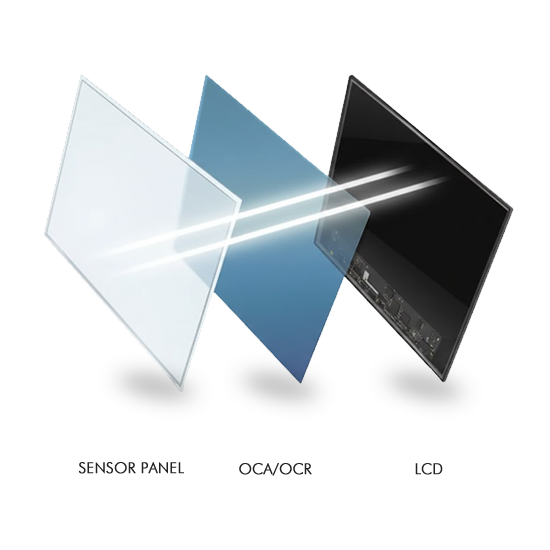
3 Core Advantages
Structural Reinforcement
Enhanced Durability By utilizing the physical support provided by OCA/OCR materials, the structural integrity of the touch panel is significantly strengthened. This enhances impact resistance and extends the product's lifespan within rigorous industrial environments.
Visual Evolution
Eliminating Reflection & Refraction By completely eliminating the air gap found in traditional air-bonding methods, internal light reflection and refraction are minimized. This ensures high contrast and crystal-clear image quality, even under direct sunlight or high-ambient light conditions.
All-Around Protection
Dust, Fog, and Moisture Resistance The gapless structure creates a hermetic seal that prevents dust and moisture penetration. It completely eliminates the risk of internal condensation (fogging) or dust accumulation between the layers, ensuring the display remains pristine at all times.

Technical Characteristics
Refractive Index Matching
We select optical-grade media with a refractive index closely matched to that of glass. This minimizes interface reflections and significantly enhances display visibility.
Material Compatibility Assessment
We provide comprehensive compatibility evaluations for various display types and cover lens materials, offering expert recommendations on material selection and stack-up structures.
High-Precision Alignment
Utilizing advanced vision alignment systems and rigorous process control, we ensure the touch sensor area and the display's active area (AA) are perfectly synchronized, minimizing the risk of offset.
Large-Format & Irregular-Shaped Bonding
We specialize in strategic planning and process parameter optimization for large-format and complex-shaped displays. Our expertise helps mitigate bonding stress issues caused by differences in Thermal Expansion Coefficients (CTE).
What Pain Points Does Optical Bonding Solve?
Washed-Out Display & Poor Contrast Under Strong Sunlight
By eliminating the air gap, optical bonding reduces internal reflection and the hazy effect caused by scattered light. This results in clearer visuals and more vivid colors—even in bright outdoor environments.
Fogging or Moisture Condensation Due to Temperature Changes
The air gap is a common source of fogging and condensation. Optical bonding fills and seals the gap, significantly reducing the likelihood of internal fogging (effectiveness may vary depending on sealing design, materials, and environmental conditions).
Vulnerability to Vibration, Rattle, or Structural Damage
The bonding material provides structural support, integrating the cover lens and display module into a unified assembly. This enhances shock and vibration resistance, reducing the risk of damage during transport or long-term operation.
Complex Supply Chain and Fragmented Responsibility
By providing a single-source solution for touch sensors, optical bonding, and final delivery, we reduce the costs of multi-party coordination and eliminate integration delays caused by fragmented accountability.
Comparison: Air Bonding vs. Optical Bonding
|
Comparison Item
|
Air Bonding
|
Optical Bonding
|
|---|---|---|
|
Internal Reflection & Haze
|
More noticeable
|
Significantly reduced (typical)
|
|
Readability in Bright Environments
|
Prone to wash-out, reduced contrast
|
Better contrast, improved readability (typical)
|
|
Risk of Fogging & Condensation
|
Higher risk
|
Lower risk (depends on sealing & environment)
|
|
Vibration & Impact Resistance
|
Weaker
|
Stronger structural integrity, improved performance (design-dependent)
|
|
Supply Chain Management
|
High coordination cost across multiple parties
|
Single-point integration, clearer accountability
|
Implementation Process
Step 1
Requirements Clarification
Define key parameters including dimensions, mechanical structure, usage environment, maintenance strategy, and targets for appearance and visibility.
Step 2
Solution Proposal
Select appropriate bonding materials, define stack-up structure, and identify potential risks.
Step 3
Sampling & Validation
Establish sampling strategy, develop test matrix, and define acceptance criteria for validation.
Step4
Mass Production Ramp-Up
Stabilize manufacturing process, implement yield control, and manage delivery documentation with full traceability.
GZE Takes Full Ownership of Process Yield Management – Single-Point After-Sales Support
We specialize in the development of large-format (up to 55 inches) and irregular/curved surface bonding solutions. Using automated alignment equipment for high-precision lamination and optimizing vacuum lamination parameters, we effectively resolve stress issues caused by differences in coefficients of thermal expansion — ensuring outstanding optical clarity and stability even in extreme environments.
Application Cases

Medical Device Displays
Goals: Easy-to-clean surfaces, anti-fingerprint (AF) properties, reduced glare interference, and enhanced display clarity for critical data recognition.

Outdoor Equipment
Goals: Minimized reflections, superior sunlight readability, reduced risk of internal fogging (condensation), and enhanced overall durability for harsh environments.
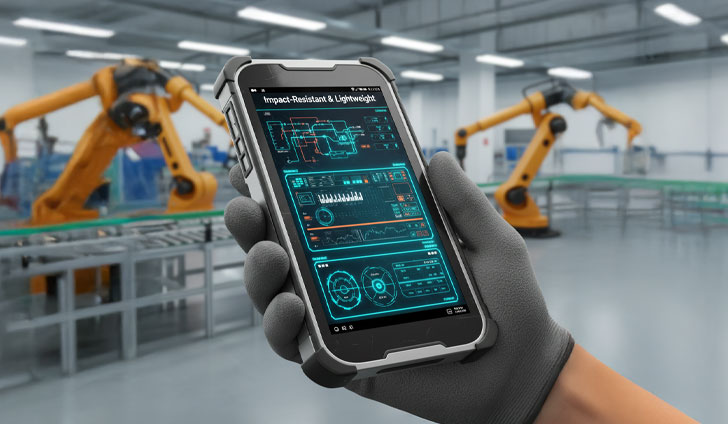
Industrial Human-Machine Interface (HMI)
Goals: Vibration and shock resistance, stable operation under extreme temperature fluctuations, and minimized reflection interference for seamless interaction.
FAQ
What is the main difference between Optical Bonding and Air Bonding?
The difference lies in whether the air gap is eliminated. Optical bonding fills and seals the gap with an optical-grade adhesive, reducing reflection, improving contrast and readability, and lowering the risk of fogging, dust ingress, and moisture-related issues (depending on structure and environment).
How do I choose between the two bonding media (OCA tape vs. OCR liquid)?
A:It depends on product structure and application scenario.
- OCA (Optically Clear Adhesive): Ideal for flat-surface designs and small to medium-sized displays, offering excellent thickness uniformity and high processing speed.
- OCR (Optically Clear Resin): Suitable for large-size displays, curved surfaces, or frame adhesive designs with height differences, providing enhanced impact resistance, shock absorption, and gap-filling capabilities. GZE’s technical team will recommend the most suitable material solution based on your mechanical design.
What specific protection effects does Optical Bonding provide?
Optical bonding enhances structural durability and sealing, reducing the risk of fogging, dust ingress, and moisture-related issues. For higher protection levels, additional enclosure sealing and mechanical design considerations are required (project-dependent).
Is the display still repairable after Optical Bonding?
Optical bonding is a highly integrated process, so the repair strategy should be defined during the design phase. The feasibility and cost of rework can be evaluated on a project basis, and pre-shipment validation helps minimize failure rates.
Can you support large-format and irregular-shaped bonding?
We can evaluate. Please provide dimensions, stack-up structure, materials, and environmental conditions. We will reply with a feasible solution and potential risks (subject to the project).
What information is required to initiate an Optical Bonding project?
To initiate an evaluation, please provide the following information: dimensions, mechanical stack-up (or structural sketch), display type, usage environment, readability targets, and maintenance/repair strategy.