


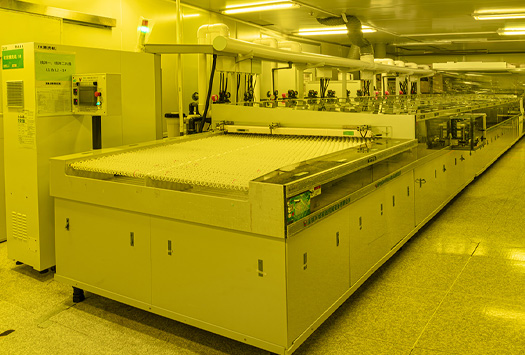
Sheet-Fed Production Line

Ultimate Clarity for Large Formats, Defining Durability for Professional Displays

Enabling Customization and High-Mix, Low-Volume Production with High-Precision Processing—While Maintaining Consistency and Scalability

Compared to continuous roll-to-roll processes, the sheet-fed production line is ideal for touch projects that demand “custom flexibility, irregular shapes, rapid prototyping, and high-mix, low-volume runs.” With high-precision manufacturing and standardized control procedures, we support touch sensor fabrication and pre-integration processes for modules. Project-specific sampling, inspection, and traceability data can be provided to ensure greater control over both prototyping and mass production delivery.

Quick Overview

  • Suitable Projects: High-mix, low-volume production, irregular shapes, rapid prototyping, and highly customized touch applications.
  • Process Features: Sheet-fed processing enables precise dimensional control and alignment, enhancing customization flexibility.
  • Delivery Support: Sampling plans, inspection data, and batch traceability available based on project requirements.

What Pain Points Does the Sheet-to-Sheet Production Line Solve?

  • Choose Sheet-Fed If:
    High customization is required
    Dimensions and shapes vary frequently
    Fast prototyping and iterative small-batch adjustments are needed
  • Choose R2R If:
    Specifications are relatively fixed
    Volume is high
    Better cost structure and faster production takt time are priorities
  • Not sure which process fits your project?
    We can recommend the optimal manufacturing path based on your size, structure, and estimated monthly volume.
片材生產 1.玻璃清洗
1

Glass Cleaning

Description: Multi-stage cleaning process for pre-cut individual glass substrates. Advantages: Thoroughly removes micro-dust and contaminants, providing optimal surface cleanliness for high-precision DITO (Double-sided ITO) coating and printing.
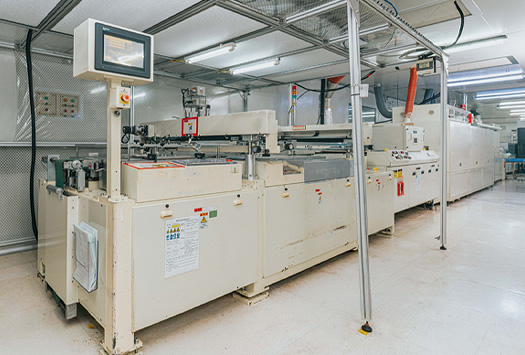
片材生產線 2.抗蝕印刷
2

Resist Printing

Description: Precise printing of etching resist onto individual glass sheets. Advantages: Sheet-based processing offers superior alignment accuracy, ensuring the stability of circuit patterns on rigid substrates.
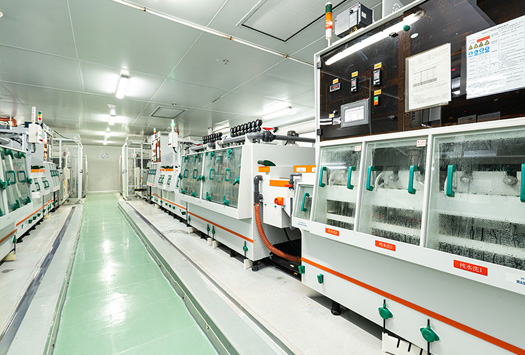
片材生產線 3.蝕刻
3

Etching

Description: Removing unprotected ITO layers to form transparent conductive traces.
Advantages: Utilizing stable sheet-immersion or spray etching to achieve sharp-edged traces and uniform impedance across the sensor circuitry.
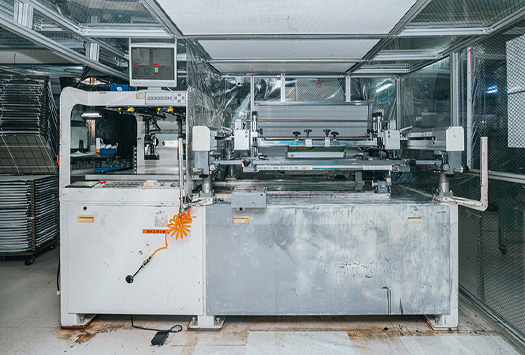
片材生產線 4.電路印刷
4

Circuit Printing (FPC / Silver Paste)

Description: Printing metallic conductive traces (such as silver paste) onto the glass periphery. Advantages: Achieves low-resistance signal transmission, optimizing the touch response speed for large-format panels.
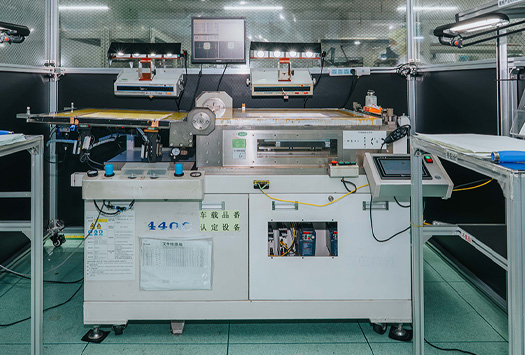
片材生產線 5.貼合
5

OCA Lamination (Sensor Assembly)

Description: Assembling the sensor and bonding it to the touch panel using OCA (Optically Clear Adhesive).
Advantages: A core proprietary technology. Our specialized environment ensures flawless bubble exclusion, achieving maximum optical transmittance.
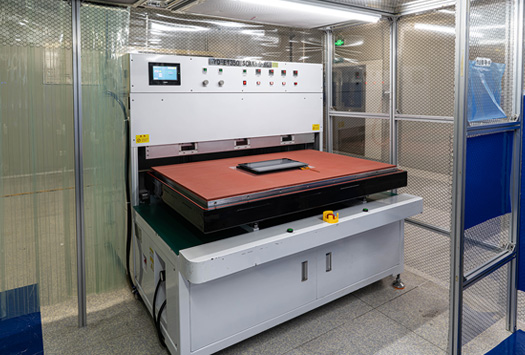
片材生產線 6.真空貼合
6

Vacuum Lamination (LCM & TP)

Description: Final assembly where the LCD and touch panel are vacuum-bonded together using OCA.
Advantages: Our flagship technology supporting large-format displays up to 55 inches. The vacuum environment ensures a perfect, bubble-free finish, delivering peak optical clarity and contrast.